
SYNTHETIC GLADIATOR
The Mechanical Horizon of Bloodsports

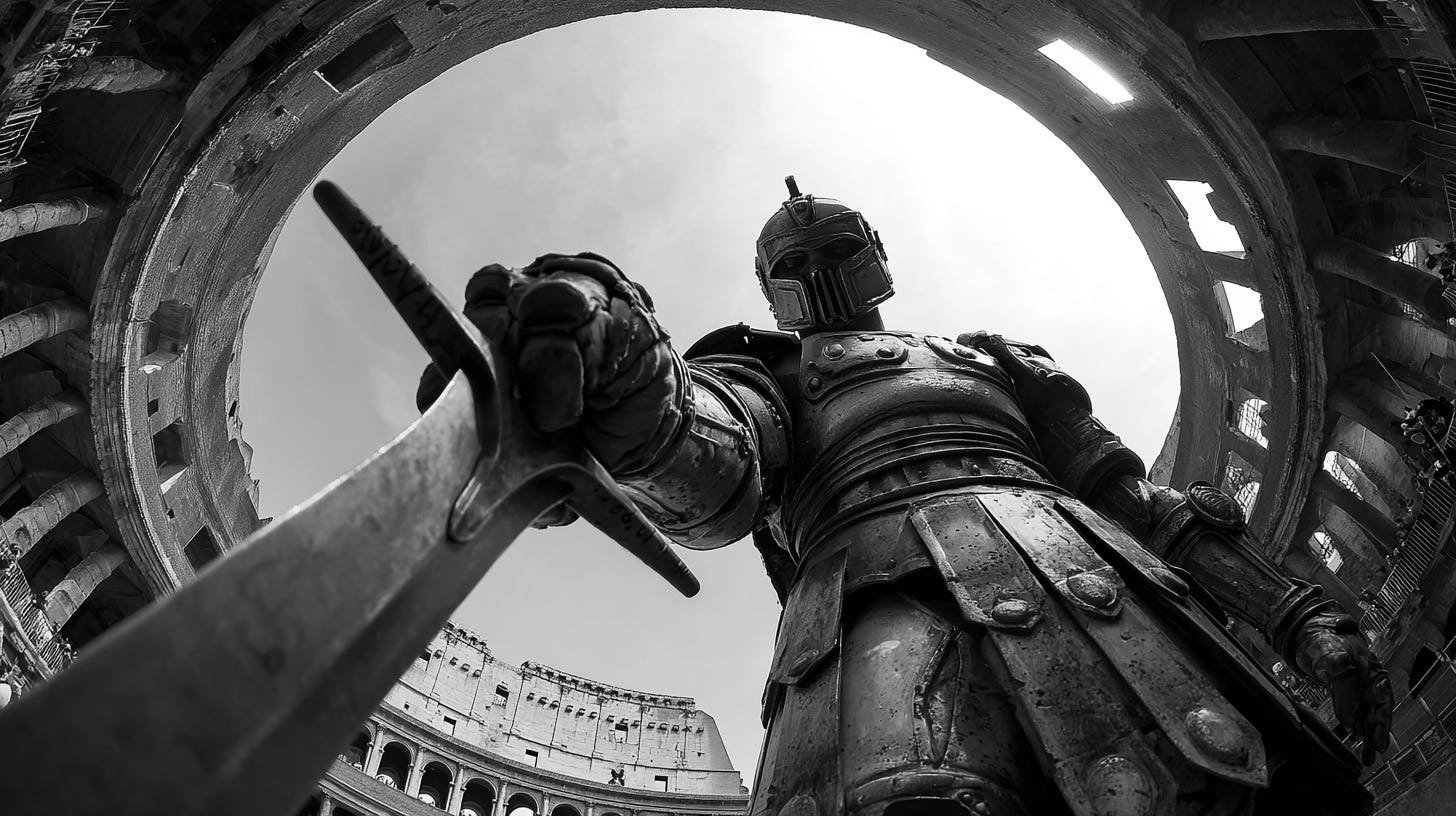
The question isn’t whether synthetic combat sport will arrive, it’s already here, dispersed across robot fight clubs in San Francisco and in the latent appetite of 640 million existing esports viewers. The real question is what form of consciousness will have been engineered in us, as synthetic combat becomes a bloodsport. The question of who will step forward to duel with a robot is answered in the 202,586 volunteers already registered for a one-way suicide mission to Mars. In this new gladiatorial future, violence bifurcates into hyperreal simulation for the comfortable and brutal material reality for the desperate. Let’s ask what it means when the first human dies at the hands of a machine built explicitly for entertainment violence.
The symbolic rupture of first blood
When the first person dies at the hands of a robot in a sporting environment, we cross a threshold that cannot be uncrossed. The legal mechanics are predictable: civil product liability settlements rather than criminal prosecution, following the Uber autonomous vehicle pattern, where the safety backup driver faced charges but the manufacturer reached confidential settlement. Multiple defendants, robot manufacturer, software developer, venue operator, regulatory body: all will face a litigation web splitting liability across the supply chain. The UFC fighter earning $42,000 annually while working a second job establishes the precedent. Combat sports participants assume risk through consent doctrine, and when deaths occur, the median settlement hovers around $116,000 to $275,000 based on regulatory negligence cases.
But the symbolic dimension operates on an entirely different logic. The Challenger disaster killed seven people and became a generational trauma, replayed endlessly, reshaping NASA for decades. When Columbia broke apart seventeen years later with an identical death toll, it “didn’t hit the country in the gut the way the first one did.” First deaths write the rules, they possess symbolic power that subsequent tragedies cannot replicate. Ayrton Senna’s steering column failure triggered criminal manslaughter prosecution in Italy and revolutionised Formula 1 safety, creating a twenty-year gap before the next driver death. The pattern is consistent: first deaths in new domains create ruptures that force society to confront what it’s created.
The first robot-caused sporting death will be different from autonomous vehicle accidents or industrial robot malfunctions because it crosses the boundary of intentional machine violence against humans for entertainment. This isn’t mechanical failure during transportation or a workplace incident. This is a societally sanctioned violence delivery system, and our collective discovery that they deliver. The video will be unavoidable, the social media dissemination instantaneous, the ethical debates all-consuming. We’ll be forced to process not just a death but what that death reveals about what we’ve become.
The likely victim already exists in the queue. Research shows dangerous opportunities attract volunteers in inverse proportion to safety. Mars One’s one-way mission received 202,586 applications, early astronaut programs with weekly test pilot deaths had thousands of applicants, and underground robot fight clubs in San Francisco have hundreds lining the block for invitation only events. The volunteer will likely be male, in their twenties or thirties, from lower-middle to poor economic background, motivated 60% by economic necessity and 40% by the symbolic capital of being “first.” Roger Bannister’s sub-four-minute mile is remembered eternally while John Landy’s faster time three weeks later is forgotten. Immortality through priority is real symbolic capital, and people calculate everyday that eternal fame justifies mortal risk.
Being the first to die in robot combat carries different symbolic weight than being first to summit Everest. Hillary and Tenzing became international celebrities overnight for conquering nature. The first robot combat death makes you a cautionary tale, a data point, a martyr? But for what cause? Economic desperation? Technological hubris? Entertainment value? The ambiguity of the symbolic capital makes the volunteer psychology even more fascinating and disturbing.
Class mechanics: who watches, who bleeds
The bifurcation of violence consumption versus violence performance runs along those old, deep economic fault lines of Rome. Video gaming generates $187.7 billion annually with 3.4 billion participants across all income levels, consumption is democratic when the violence is pixelated. Combat sports tell the opposite story: the average MMA fighter earns $38,000 lifetime, less than two years of minimum wage work, while working second jobs as repo men, truck drivers, and bartenders between fights that leave them with chronic traumatic encephalopathy. The median UFC salary is $42,000 annually, fighters receive 15.6% of revenue while NFL players receive 40-55%. Georges St-Pierre stated it plainly: “Most fighters in the UFC, they are starving. And when you keep a lot of your staff starving, they are easier to control.”
The research debunks the “fighting out of poverty” mythology. Even quadrupling poverty-level fight purses still qualifies as poverty. The greatest fighters historically came from middle-class backgrounds with access to training infrastructure. But Francis Ngannou was homeless in Paris before fighting, Alex Pereira worked tire shops in Brazilian favelas before kickboxing, and Jose Aldo slept in gyms eating one meal daily. Economic desperation creates supply, but the pathway to wealth is a statistical fantasy. Only 6.8% of UFC fighters achieve career millionaire status. The rest destroy their bodies for poverty wages while comfortable populations consume their suffering as entertainment.
We return to the gladiatorial economics of Rome. Patricians watched from shaded luxury seating with water misters while slaves and prisoners fought below. Some gladiators achieved celebrity status, endorsed products, inspired sexual fascination, legitimising a system where the vast majority died anonymously. Our modern wealth concentration repeats the dynamic. 800 US billionaires worth $6.72 trillion collectively while 36% of households cannot afford basic expenses, $18 trillion in household debt, and the emergence of the “precariat” class living without economic predictability or security. This precarious class forms the natural supply for dangerous work. Economic insecurity removes better options, physical capability becomes a robust marketable asset, short-term cash needs override long-term health concerns.
But the bifurcation operates at a deeper level than simple class exploitation. Violence is becoming hyperreal in simulation. Photorealistic VR games like Blade & Sorcery feature “medically accurate damage effects” and physics-driven dismemberment, AI may soon generate infinite procedural variations of ultrarealistic beings to destroy, while deepfake technology will invariably create indistinguishable digital humans that can be subjected to any violence without ethical constraints. Meanwhile actual violence becomes brutally material for those who perform it. Real broken bones, traumatic brain injuries and real lifetime earnings of $38,000.
The comfortable populations play increasingly realistic fighting games but never engage physical violence. The desperate populations economically driven toward actual gladiatorial combat with machines, face consequences no simulation captures. Gaming demographics show income barely affects participation, 34% in top income bracket game regularly. Combat sports demographics show overwhelming concentration of participants from lower economic strata. The same culture producing GTA as an $8 billion franchise pays actual fighters $30,000 annually to sustain brain damage.
Victorian society provides our historical bridge. Upper classes promoted amateurism and sport as a gentlemanly pursuit while working classes needed payment for participation, couldn’t afford time away from labor and saw physical capability as a commodity. The amateur/professional split encoded class hierarchy. Patricians claimed moral superiority of play for pleasure while extracting profit from working-class bodies performing violence. We perfected this dynamic. The violence-consumption industry generates hundreds of billions annually while violence-performers earn poverty wages and risk permanent disability.
The strange economics of volunteering for violence
More than 90% of clinical trial volunteers cite money as the primary motivation, yet test pilots in the 1950s died weekly and volunteers continued lining up for the symbolic capital of being first. The psychology of dangerous “firsts” reveals dual pathways converging on identical endpoints: economic desperation and aspirational transcendence, both leading to the same queue.
The “desperation threshold” model explains the economic path. Below critical resource levels, people become risk-preferring because “If a risky option is successful, it will allow them to leap back over the threshold. If not, their prospects will be no more dire than they were anyway.” Clinical trials pay a median $3,070 with professional participants enrolling in 6-22 trials over three years. Phase I trials pay highest because treatments are the least understood, payment signals risk level. The US provides no compensation guarantee for injured trial participants despite 60% of research centers lacking injury support policies. People in poverty do “the most dangerous jobs” not from character defects but from economic coercion, when the system locks people out, they resort to dangerous alternatives.
The aspirational path operates on entirely different logic but reaches identical dangerous opportunities. NASA astronaut selection emphasises adaptability and psychological resilience, not risk-seeking behavior, astronauts are “selected to be generally free of psychological problems.” Extreme sports participants aren’t (generally) irresponsible death-wishers but highly trained individuals seeking life-enhancing experiences of freedom and transcendence. They’re motivated by competence, autonomy and self-actualisation. Needs at the top of Maslow’s hierarchy, not the bottom.
Both pathways converge on dangerous firsts because symbolic capital is real and valuable. Roger Bannister is remembered eternally, John Landy’s faster time forgotten. Hillary and Tenzing became international celebrities overnight, with news reaching London on Queen Elizabeth’s coronation day, creating the perfect storm of imperial celebration. Neil Armstrong will be “remembered 1,000 years from now.” The immortality through priority is rational calculation. Mortality risk is exchanged for eternal recognition.
Pierre Bourdieu’s symbolic capital theory explains the mechanism. Resources based on honor, prestige, recognition freely convert into economic and social capital. Andrew Carnegie’s philanthropic foundations obscured his wealth extraction from child laborers, symbolic capital launders material exploitation. The “first” position carries unique symbolic weight that second place cannot capture regardless of superior performance. This creates a perverse incentive structure where danger increases volunteer supply rather than decreasing it. The more dangerous opportunities are scarcer, exclusive and carry higher symbolic capital. Simply, they attract more volunteers.
For synthetic bloodsport our volunteer profile prediction is as follows: The primary demographic will be young males from lower-middle to poor economic backgrounds, secondary demographic tech enthusiasts seeking first-adopter status, tertiary demographic former combat sports athletes seeking a new frontier. Payment must exceed $50,000 to attract a desperate population while remaining below $100,000 to avoid a “coercive” perception.
Current robot fight clubs, REK, Ultimate Fighting Bots, feature humans piloting humanoid robots via VR or motion-capture suits. The violence is real (robots physically destroying each other) but human bodies are separated from consequences. This creates a hybrid form, maintaining the competitive skill requirement and destructive spectacle while removing human mortality risk. Its Tekken-style gaming merged with actual physical destruction, satisfying multiple psychological needs simultaneously. Game skills, and “real” consequences, devoured by the spectacle of machines battling. If this model scales satisfyingly, it could eliminate the supply constraint of human bodies willing to face robots, while maintaining gladiatorial entertainment value. Assuming we stop at robot-versus-robot. Our mammalian drive toward escalation suggests otherwise.
Rome and the attention economy
We’re already past Roman levels of entertainment consumption by absolute hours. Romans devoted 135-175 days annually to games at peak (350 AD), approximately 1,080-1,400 hours. Modern Americans average 7 hours daily screen time. 2,555 hours annually, more than double Roman festival allocation. The difference isn’t quantity but quality. Roman games were collective public ritual serving political legitimacy while modern entertainment is a form of atomised private consumption serving corporate profit.
The comparison reveals both continuity and a new rupture. The continuity is that both societies devote massive portions or time to entertainment. They use violence as a major content category, build enormous infrastructure for spectacle delivery, and recognise entertainment as a tool for social management. The phrase “bread and circuses” describes a mechanism unchanged across millennia. Pacification through provision of basic sustenance and diverting entertainment, creating public approval “not by excellence in public service but by diversion, distraction, or by satisfying the most immediate or base requirements of a populace.”
The rupture lies in social function and structure. Romans required physical presence at specific times, games on the festival calendar created shared experiences, collective memory, community bonding. The scarcity made events special, the social gathering reinforced civic identity, the political theater maintained imperial legitimacy. Modern streaming creates the opposite effect. Unlimited abundance creates a paradox where 29% feel “frustrated/overwhelmed” by choices, isolated consumption reduces social cohesion, algorithmic curation personalises violence feeds for individual users, while private viewing eliminates shared cultural moments.
Rome’s Colosseum held 50-80,000, roughly 5-8% of a metropolitan population. Netflix has 301.6 million subscribers, 3.8% of the global population. Streaming services collectively reach 1.1 billion subscribers. The infrastructure scale vastly exceeds Rome’s capacity, but the experience fundamentally differs. Romans watched real people dying in front of them. We watch fictional violence, heavily regulated professional sports with safety measures, or algorithmically curated real-world violence clips. The volume of violent content exposure vastly exceeds Rome. The average American youth sees 200,000 violent acts on screens before the age 18.
The Circus Maximus held 250,000 spectators, 25% of Rome’s million-person population simultaneously witnessing chariot racing. League of Legends 2024 World Championship drew 6.86 million peak viewers, and the global esports audience reached 640 million. We’ve built infrastructure for constant violent entertainment that makes the scope of Roman bread and circuses look quaint by comparison, but we’ve also changed what “violence” means.
Streaming and on-demand fundamentally alters spectacle delivery. There are no real temporal constraints (consume violence 24/7), personalised algorithms (violence-seekers receive endless recommendations), social regulation elimination (private consumption, minimal oversight), binge-watching intensification (5-hour sessions compress exposure), lower barrier to entry ($10 monthly subscription versus traveling to The Colosseum), content volume explosion (Netflix releases 700+ titles annually versus Rome’s 200-300 gladiator bouts yearly).
The result isn’t a return to Roman imperial games but the creation of something more pervasive and insidious. A hyper-personalised, always-available, algorithmically-curated distraction that exceeds Rome in time allocation and infrastructural scale while operating through fundamentally different mechanisms. We’ve built an attention economy that extracts more total hours from more people across more devices than Roman emperors imagined possible. Delivering experiences in fragmented, isolated, individually optimised streams rather than collective spectacles.
For synthetic bloodsport, this creates the perfect conditions. An infrastructure exists for continuous programming, an audience appetite proven through 640 million esports viewers, streaming economics enable niche content profitability, and algorithmic distribution ensures violence-seekers find violent content. Our infrastructures can support constant gladiatorial spectacle, they already do. Distributed across gaming, sports and the staggering miscellany of real violence media.
From what substrate do we watch beings destroyed
Consuming violent spectacle alters our consciousness at a neurological level independent of viewer awareness. Initial exposure triggers discomfort, fear and elevated heart rate. Natural protective responses. Repeated exposure fundamentally rewires these reactions. Viewers become desensitised, violent stimuli lose the capacity to elicit strong emotions. Heavy consumers show increased pleasant arousal and decreased anxious arousal when viewing violence. The emotional response inverts, with violence becoming pleasurable rather than disturbing.
Brain imaging reveals the mechanism. Media violence exposure reduces activity in the lateral orbitofrontal cortex and anterior cingulate cortex. Regions responsible for suppressing aggressive behaviors, while areas associated with planning behaviors become more active. Violence viewing diminishes behavioral inhibition while enhancing aggressive cognition. The effects are measurable, 15-year longitudinal studies show childhood violence exposure predicts aggressive behavior decades later, with 11% of high-violence viewers having criminal convictions versus 3% of low-violence viewers, and a further 42% physically assaulting spouses versus 22%.
Priming makes aggressive concepts more accessible, arousal transfer mis-attributes emotional activation to subsequent situations, script learning creates automatic violent behavioral patterns, world schema distortion biases perception toward attributing hostility to others. Most critically: empathy degrades. Exposure reduces sympathy for victims in mediated and real-world contexts, decreased prosocial behavior, reduced neural responsiveness to violence among habitual consumers.
This isn’t an abstracted theory, it’s a neurological fact. And it happens regardless of whether the violence is “real” or “synthetic.” The brain’s response systems don’t distinguish between fictional and authentic violence in immediate reactions. Desensitisation occurs with both. Script learning and norm-shifting happen equally. The “synthetic” nature of a given future bloodsport doesn’t protect consciousness from its alteration, it potentially accelerates the process by removing the ethical barriers to consumption.
But the conscious state of audiences isn’t solely determined by what they watch. It’s fundamentally shaped by material conditions from which they watch. Modern viewers consume violent spectacles from a position of profound economic precarity. 36% cannot afford basic household expenses, $18 trillion in household debt, 7% of credit accounts in serious delinquency, with only 72% doing “at least okay financially.” Financial insecurity increased 25% among 18-24 year-olds in two years. The precariat class, those living without economic predictability or security, form the primary audience for escapist entertainment.
Economic precarity breeds specific psychological patterns, such as chronic stress from baseline anxiety, a future-foreclosed orientation, as traditional milestones feel impossible. Atomised isolation as competition dissolves community, with their cognitive load consumed by survival, leaving little room for long term thought. From this position, violent spectacle serves multiple functions. A distraction from unbearable circumstances, a vicarious experience of power and agency denied in actual life. An emotional release of accumulated stressors, a status fantasy through consuming premium content, and the enforcement of passivity, as exhaustion makes active citizenship impossible.
The triple bind emerges: material necessity makes escapism psychologically necessary, consciousness engineering systematically shapes desires and perceptions through spectacle consumption. While the consumption of violent spectacle degrades empathy and normalises violence, yet refusing consumption means confronting an increasingly unbearable reality without any buffer. Audiences watch from economic precarity, through a consciousness altered by perpetual violence exposure, seeking an escape that further alters consciousness while serving a social control function.
Guy Debord identified in 1967 that the spectacle is “a social relation among people, mediated by images” where “all that once was directly lived has become mere representation.” The spectacle isn’t a supplement to real society but its heart. A perfected separation where authentic social life has been replaced with representation. His thesis 30 captures the mechanism: “The more he contemplates the less he lives; the more he accepts recognising himself in the dominant images of need, the less he understands his own existence and desires.”
Foucault adds the disciplinary dimension. Power no longer operates primarily through violence and threat but through surveillance and normalisation, subjects internalise observation and self-regulate. The contemporary evolution is that control embeds itself in “widespread and often consensual interaction between users, outlets and systems of institutional action.” We volunteer for consciousness engineering through entertainment platforms. The algorithms curate personalised violence feeds, the binge-watching creates dopamine addiction cycles, the isolation prevents collective processing, the precarity ensures continued consumption as a pressure valve.
The ethics of spectatorship reveals intrinsic complicity. Watching suffering for pleasure, whether real or synthetic, makes viewers participate in moral degradation. Research shows voyeuristic consumption involves “the power to subject another to the will sadistically, or to the gaze voyeuristically”, the viewer maintains a privileged position as subject while watched become objects. The “sadistic position of viewing a moment of pain, violence, or perversity is in some way accepting that pictorial reality.” The market logic completes the loop: “We consume content we know we shouldn’t, the market sees this objectively, it makes more.”
For synthetic bloodsport specifically, the consciousness effects remain identical whether violence is “real” or “artificial.” The neurological desensitisation occurs regardless of content authenticity. The empathy degradation happens with fictional and real violence equally. Dopamine addiction cycles function identically. The difference is ethical distancing: “it’s not real” paradoxically makes consumption easier and effects stronger because moral barriers are removed. Perfectly controlled, algorithmically optimised, maximally addictive violence can be engineered when freed from constraints of actual human bodies and ethical objections to real death.
The autopoietic loops of violence production and consumption
Deep patterns reveal themselves in this recursion. Economic inequality creates a precariat class requiring social management. Spectacle serves as a control mechanism, with “bread and circuses” updated for our now titanic attention economy. Spectacle consumption alters consciousness: reducing empathy, increasing aggressive cognition, degrading our capacity for sustained attention and collective action. Altered consciousness increases economic precarity: subjects optimised for passive consumption rather than active citizenship cannot organise resistance to exploitative systems. Increased precarity drives more spectacle consumption as pressure valves. The loop closes and intensifies.
But there’s a second loop operating simultaneously. Comfortable populations consume simulated violence, become desensitised, and demand increasingly intense stimulation. The gaming industry responds with photorealistic graphics, procedural AI generation of infinite violence variations, VR immersion creating perfect illusion. Meanwhile, economic desperation creates supply of bodies for actual violence performance. Combat sports exploit this supply, paying poverty wages to fighters while generating billions in revenue. The spectacle of actual violence becomes content consumed by desensitised populations whose simulation consumption created the appetite.
The loop couples: simulated violence consumption desensitises audiences, desensitised audiences demand novel stimulation, economic system generates desperate performers, performers provide actual violence spectacle, actual violence spectacle further desensitises consumers, cycle intensifies. Each rotation increases both realism of simulation and desperation of performers. The bifurcation deepens: violence becomes more hyperreal in pixels and more brutally material in flesh, split precisely along class lines.
Georges Bataille’s expenditure economics illuminates the deeper pattern. He identified sacred violence and sacrifice as society’s method of managing excess, the unproductive expenditure that creates meaning and social bonds. Modern synthetic bloodsport represents industrialised, commodified, infinitely reproducible sacrifice where the sacred dimension has been evacuated but the violence remains. We’ve preserved the mechanism while destroying its function: violence without transcendence, sacrifice without meaning, bloodsport without blood that somehow demands actual blood from economic margins.
Baudrillard’s hyperreality explores the simulation. We’ve created violence more real than real, perfectly crafted for consumption, freed from constraints of physics and ethics. The map precedes the territory, simulated violence becomes a template that actual violence performance must match. The MMA fighter working as a repo man between fights exists in a bizarre relationship to photorealistic fighting games: his actual suffering validates the simulation’s authenticity while simulations create audience appetite for his suffering.
The teleology of violence-as-spectacle across human history reveals disturbing patterns. From Roman gladiators, medieval tournaments to Victorian boxing, modern MMA, emerging robot combat to speculative mech-piloting leagues, each iteration maintains a core structure (economic/political elite consuming violence performed by subordinate class) while scaling technology and reach. The progression isn’t toward elimination of violent spectacle but toward its perfection. The total reach (billions of devices), constant availability (24/7 streaming), personalised delivery (algorithmic curation), consciousness optimisation (maximum engagement through addiction cycles) and ethical barriers removed (synthetic violence enables any atrocity).
Where does synthetic bloodsport fit into this evolution of consciousness? It represents a potential phase transition: the separation of violence spectacle from human bodies entirely. Robot-versus-robot combat piloted by humans via VR creates violence spectacle without mortality risk to performers, potentially solving supply constraint while maintaining competitive entertainment value. But this assumes the escalation stops there. The logic of spectacle demands intensification, why watch robots controlled by humans when you could watch actual human-robot combat? Why watch controlled sparring when you could watch death matches? Economic desperation ensures supply of volunteers. Technological capability enables any spectacle imaginable. Desensitised audiences demand novel stimulation.
The only limiting factor is collective moral revulsion. The engineering of our consciousness through spectacle consumption systematically degrades the capacity for moral revulsion. The loop is autopoietic: the system creates conditions for its own intensification.
Structural coupling and the posthuman horizon
Structural coupling describes how systems become mutually dependent and co-evolving. Human consciousness, machine intelligence, and spectacle infrastructure are entering tight coupling where each shapes the others’ development. Human audiences desensitised through violence consumption will imbibe increasingly sophisticated AI-generated content. AI training on human violence preferences learns to optimise for engagement. Optimised content further desensitises humans. The coupling tightens.
Meanwhile, robot combat represents a literal coupling. Human consciousness extended into machine bodies, experiencing violence through remote avatar, skill expressed through mechanical proxy. This isn’t simple tool use—it’s hybridisation where human and machine form combined system. The pilot-robot coupling during combat creates feedback loop: human intentions shape robot actions, robot capabilities constrain human strategies, combat outcome depends on coupling quality rather than either component alone.
The deeper coupling operates at symbolic level. As we normalise machine violence against humans (or human-piloted machines against each other, then eventually human-piloted machines against actual humans), we’re engineering consciousness that accepts machine agency over human bodies. This habituates populations to posthuman futures where machines possess legitimate capacity for violence against humans. The first death at hands of robot in sporting context establishes precedent: machines can kill humans for entertainment purposes with proper consent and regulation.
From there, the extensions are straightforward: if entertainment violence is acceptable with consent, what about military applications? Medical euthanasia? Criminal punishment? Suicide assistance? Each domain adopts precedent established by synthetic bloodsport, using identical consent and regulation frameworks. The spectacle naturalises posthuman power relations where machines possess legitimate violence capacity over human bodies.
This is consciousness engineering at a civilisational scale. The morphogenetic field, the collective pattern organising social development, shifts toward accepting machine supremacy not through explicit ideology but through entertainment habituation. Debord’s spectacle, Foucault’s discipline, Baudrillard’s hyperreality combine: consciousness shaped by images, subjects self-regulating based on internalised norms, the simulated becoming more real than real. Synthetic bloodsport serves as a vector for posthuman acculturation.
The Bataillean sacred expenditure becomes mechanised: instead of human sacrifice creating social cohesion through shared witness of death, we sacrifice humans to machines for algorithmic entertainment optimisation. The sacred is evacuated but violence persists, now serving capital accumulation and consciousness engineering rather than community formation. The machines become our new gods, not through worship but through habituation to their power over life and death.
The horizon we’re engineering
The trajectory is clear if unstated: we’re building the infrastructure and appetite for constant, personalised, AI-optimised violent spectacle, consumed by economically precarious, socially atomised, empathetically degraded populations from positions of economic desperation or comfortable isolation, depending on class position. The violence bifurcates: hyperreal simulation for comfortable classes, brutally material performance for desperate classes, with machine-human hybrid forms emerging that separate body from risk while maintaining spectacle value.
The first death at robot’s hands establishes the precedent and triggers predictable regulatory responses. It will create a symbolic rupture that forces confrontation with what we’ve built, but will not stop the process. The queue of volunteers already exists, driven by economic desperation and symbolic capital calculation. The infrastructure already exists, a system for the delivery of constant violent programming to billions. The audience already exists, desensitised through years of violent consumption and escape seeking from economic precarity. The technology already exists, enabling any spectacle from photorealistic AI-generated violence to actual robot combat.
What’s being engineered in us, is a consciousness that finds violence pleasurable, lacks empathy for suffering, cannot sustain attention or collective action, lives in representation rather than experience, accepts machine supremacy over human bodies and consumes violence to manage anxiety created by the system producing the violence. This consciousness is perfectly optimised for a passive consumption, incapable of recognising let alone resisting its own degradation, habituated to posthuman power relations through entertainment spectacle.
The world we watch from and the world we’re watching merge: economic precarity creates demand for escapist violence consumption, violence consumption engineers consciousness that perpetuates precarity through political passivity and the degradation of empathy. Engineered consciousness accepts conditions that intensify precarity. The spectacle isn’t separate from our material reality, it’s the mechanism by which a reality is preserved by preventing collective action to change it.
The throughline from simulation to materiality, comfort to desperation, watching to fighting runs through consciousness engineering. The same economic system generates both hyperreal simulation for comfortable classes and desperate performers for actual violence. The same spectacle infrastructure delivers both. The same consciousness alterations result from consuming either. The bifurcation is less separation than division of labor: some engineer and consume the simulations, others perform the material violence, but all participate in system engineering consciousness toward accepting machine violence against humans as entertainment.
Where this terminates is visible in the asymptote: perfect simulation indistinguishable from reality consumed by perfectly desensitised audiences from positions of economic precarity managed through spectacle. With actual violence performed by desperate populations separated from bourgeois consciousness by algorithmic curation, all habituated to machine supremacy through entertained normalisation. The first death is a threshold, not the terminus, it establishes the required precedent to enable future intensification.
The Deep Self question is what remains of human consciousness after complete spectacle capture: when all experience is mediated, all violence is entertainment, all suffering is content, all resistance is recuperated, and all collective agency is dissolved into atomised consumption. What remains is precisely what the system requires. Subjects optimised for passive consumption, incapable of solidarity, desensitised to suffering, accepting of machine supremacy, and seeking escape from unbearable material reality through spectacle that maintains that reality.
This is the consciousness we’re engineering. This is the world we’re creating. The synthetic bloodsport isn’t coming, it’s already here, distributed across infrastructure and consciousness, waiting only for integration into its most explicit form. When the machines draw first blood, they’ll be drawing what we’ve already given them: permission, infrastructure, audience, volunteers, and consciousness engineered to accept it all as entertainment. The spectacle always was the heart of unrealism, and that heart, it turns out, pumps blood.
The question was never whether we would build synthetic gladiatorial futures. We’re already building them, already consuming them, and already becoming the consciousness they require. The question is whether anything remains capable of recognising this and choosing differently. That capacity is precisely what spectacle consumption systematically destroys. We are, in Debord’s perfect formulation, becoming spectators of our own lives, watching the future arrive while losing the agency to shape it, entertained by our own obsolescence, consuming the violence that consumes us, separated from everything including the fact of our separation.