
MINIMUM VIABLE WORKER
Psychiatry’s War Against the Mystic

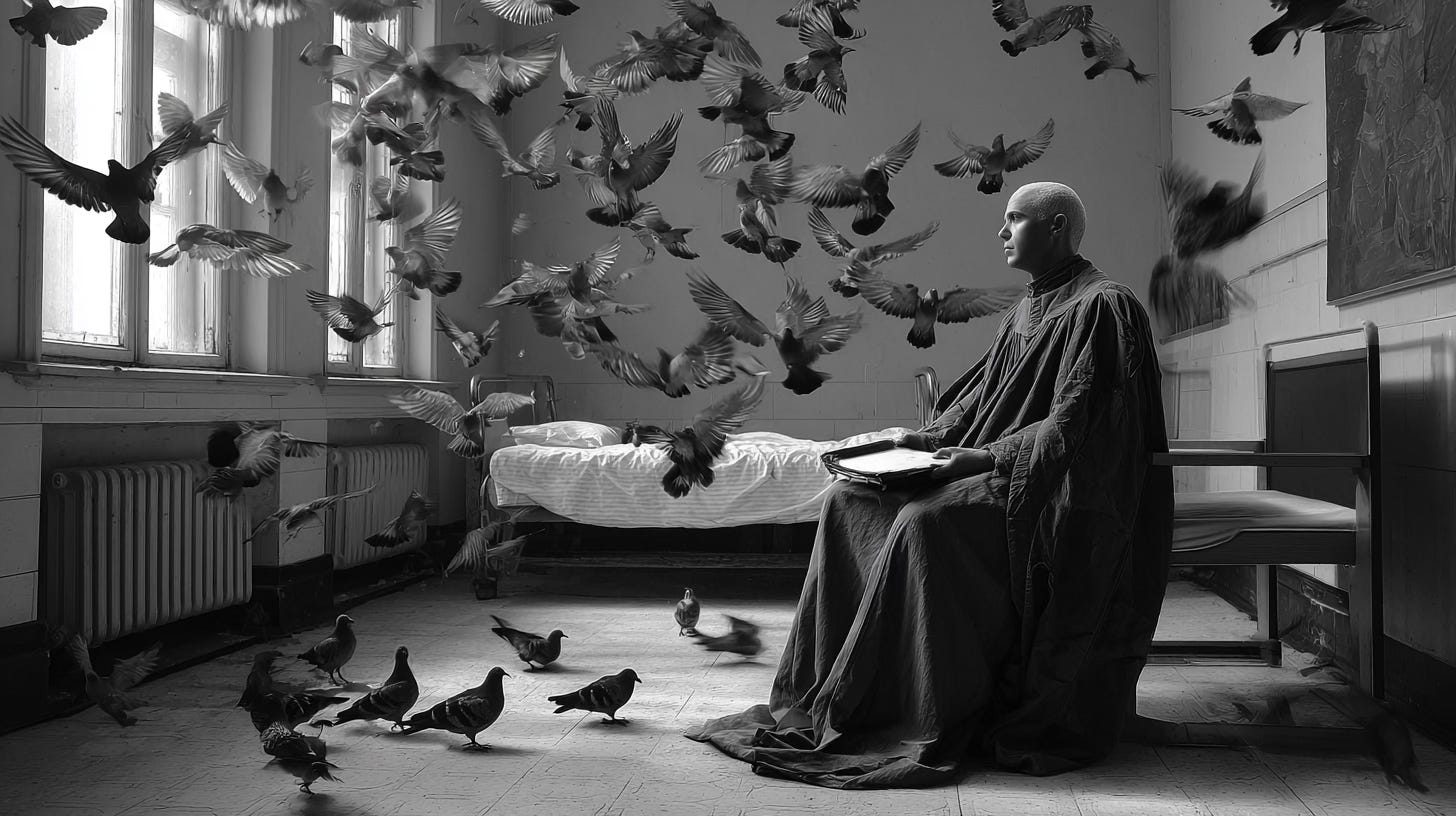
Saint Francis of Assisi spoke to birds. Not metaphorically. He stood in the Spoleto Valley and preached to sparrows who waited without scattering. He walked through flocks, touching their bodies with his tunic. He freed trapped rabbits with warnings not to be caught again. His companion Brother Juniper preferred seesawing for hours instead of human company. Juniper stripped naked in literal interpretation of Franciscan poverty, moving with what contemporaries called “stereotypical movements.” When told to moderate, he could not recognise the social cue.
What do we gain by calling them autistic? What specific benefit accrues to human understanding when we translate the “saint who spoke with animals” into an “individual with autism spectrum disorder”? What does the world receive in exchange for this vocabulary?
The question isn’t whether Francis exhibited traits that match contemporary diagnostic criteria. He did. The question is, so what? What does the diagnostic label do that the word “mystic” fails to accomplish? The answer, when you follow it all the way down, reveals the only thing psychiatry was ever designed to do. To create a ‘Minimum Viable Worker’.
The Sacred Economy of Difference
For most of human history, the person who saw visions occupied a specific seat at the table of civilisation. The shaman, oracle, fool, anchorite and mystic. These weren’t metaphors or polite euphemisms for “mentally ill persons we tolerate.” They were jobs. Professions. Social positions with defined functions and recognised authority.
When your child spent hours staring at shadows on walls, indigenous cultures asked, is this one called to be a seer? When someone spoke in ecstatic utterances, medieval Europe asked, is this divine inspiration? When a person required solitude and silence to function, monasteries asked, is this one meant for contemplative life?
The question was never “what’s wrong with them?” but “what are they for?”
Julian of Norwich lived in a cell the size of a bedroom for forty years. At her enclosure ceremony, the bishop recited the office of the dead. She was legally, liturgically dead to the world. One window to the church, one to her servant and one to those seeking spiritual counsel. This wasn’t a prison. This was infrastructure. The anchorhold was a built architecture, a social technology for hosting the kind of consciousness that cannot survive in crowds.
From that cell, Julian wrote Theology that shaped civilisations. Yet modern psychiatry would diagnose her with with severe agoraphobia requiring immediate intervention. What exactly would we have gained by getting Julian on SSRIs and into behavioural therapy until she could tolerate the marketplace?
What precisely does the world receives when we trade the status of a mystic whose withdrawal produces sacred text, for that of a patient whose withdrawal requires correction from pathology.
Psychiatry exists to produce minimum viable workers. Not maximum human flourishing. Not sacred service. Not theological brilliance, artistic transcendence or prophetic witness. Minimum viable functionality within capitalist production.
It’s explicit in the metrics. Recovery is measured by employment status, treatment goals are written as “return to work” and “maintain job performance.” The success criteria for psychiatric intervention is whether you can pull the assigned lever at your assigned station without disrupting production.
When Britain’s Department of Work and Pensions funds mental health treatment, they measure return on investment in reduced disability claims and increased tax revenue from employment. The equation is plain: we will invest in your mental health to the extent it increases your economic productivity. No further.
This is why alcohol is essential to industrial society while psychedelics are Schedule I. Alcohol makes you tolerable to intolerable conditions. It numbs without illuminating. It smooths the rage that might otherwise ask why you spend your life enriching someone else’s. Alcohol is an anti-shamanic medicant, suppressing visions that might reveal your captivity.
Psychedelics do the opposite. They make intolerable conditions intolerable. They illuminate precisely what alcohol obscures. They generate the kinds of questions that threaten labor compliance: Why am I doing this? Who benefits from my suffering? What would my life be if I followed what calls me instead of what employs me?
The logic that governs psychiatric medication is never “does this help them flourish?” The question is “does this help them function?” And function means one thing: economic productivity.
What we call “treatment-resistant depression” means “resistant to returning to conditions that cause depression.” The person isn’t sick. The conditions are sick. But psychiatry can’t fix conditions. It can only fix people into conditions.
What dies in translation
When you translate “mystic” into “neurodivergent,” something dies that cannot be easily resurrected. The neurodivergence framework, even in its most progressive, celebratory forms, operates within a pathological paradigm. The starting assumption is medical. Different is divergent. Divergent is diagnostic. Diagnostic is deficit.
The mystic framework operated from opposite ontology.
The difference wasn’t divergent. It was specialised. The person who couldn’t tolerate crowds wasn’t deficient in social function. They were capable of solitary depths that crowd-dwellers cannot reach. The person who spoke to animals wasn’t failing at human communication. They had access to non-human communication that human-focused people lack.
This isn’t romantic primitivism. This is documented anthropology.
Over 90% of human societies throughout history recognised certain people as specially gifted in ways that required different environmental supports. Not disordered. Differently ordered. Ordered toward functions the majority cannot perform.
The shaman’s calling is often marked by what psychiatry calls “mental illness”, dissociative episodes, auditory hallucinations, severe social anxiety and what we’d diagnose as schizophrenia or bipolar disorder. But shamanic cultures don’t ask “how do we fix this?” They ask “how do we train this?”
The Siberian peoples have protocols for shamanic crises that look nothing like psychiatric hospitalisation. The person experiencing visions isn’t medicated into baseline functioning. They’re supported through the crisis toward emergence as healers. The symptoms aren’t reduced. They’re refined. Shaped. Directed toward communal service.
The skills that mark shamanic calling, heightened sensitivity to subtle environmental changes, capacity for trance states, communication with non-ordinary reality, these are precisely the traits that mark psychiatric intervention in industrial societies. Because industrial societies don’t need shamans. They need workers. They need people who can tolerate fluorescent lights and eight-hour shifts and bosses who treat them as replaceable. They need consciousness that submits to repetition without questioning the purpose of the repetition. Mysticism produces the opposite. It produces consciousness that asks: what am I for? What serves the sacred? What calls me beyond survival into purpose? These are anti-capitalist questions. They threaten the entire apparatus.
The Monastery as Counter-Institution
By industrial logic, monasteries are commercially incoherent. You take people who can’t function in normal society: too quiet, too intense, too obsessed with intangible concerns, and you put them together in small communities with rigid daily structures and no reproductive future. Social Darwinism says this fails. These are the least fit. They should be outcompeted, absorbed, eliminated.
Instead, monasteries preserved civilisation through the collapse of Rome. They maintained literacy, developed agricultural techniques, provided healthcare, educated the poor and produced theological and artistic works that shaped European consciousness for a millennium.
They were not warehousing dysfunction. They were concentrating gift.
The person who needs eight hours of solitary prayer daily isn’t broken. They’re mystically gifted. The person who can’t tolerate small talk isn’t socially deficient. They’re incapable of superficiality. The person obsessed with manuscript illumination to the exclusion of all else isn’t pathologically fixated. They’re accessing depths of focus that produce extraordinary beauty.
Monasteries were infrastructure for consciousness that couldn’t survive outside them. Not hospitals. Not asylums. Infrastructure. Social technology for hosting modes of being that the marketplace destroys.
This is what died when we medicalised the difference.
We lost the social architecture that could ask: what environmental conditions allow this consciousness to serve? We replaced it with: what pharmaceutical intervention returns this person to normative function?
The monastery said: you’re too intense for village life, but we have a place for intensity.
Psychiatry says: you’re too intense for economic productivity, so we’ll reduce your intensity until you can tolerate your job.
These are not equivalent propositions. One builds institutions around human diversity. The other builds interventions around capitalist requirements.
The word that changes everything
The word isn’t “neurodivergent.” It’s “mystic.” And the difference isn’t semantic. It’s ontological. When you call someone neurodivergent, you’re marking distance from baseline. When you call someone mystic, you’re marking access to depth. Divergence is a deficit geography, while mysticism is the geography of a gift. This matters practically.
If Francis is autistic, the intervention is: how do we help him tolerate social situations? If Francis is mystic, the question is: what conditions allow his consciousness to serve?
If Julian is agoraphobic, then we must get her out of that cell? If Julian is anchorite, the question becomes, what does her withdrawal produce for the world that couldn’t overwise wise exist?
The neurodivergent framework, despite all attempts at reclamation, still operates within the medical model. It still assumes neurotypical as the reference point. It still treats difference as something requiring accommodation rather than producing specific capability.
The mystic framework assumes no baseline. There is no neurotypical. There are only different modes of consciousness with different affordances. The person who sees visions isn’t diverging from the person who doesn’t, they’re accessing highly specific bandwidths of reality.
This isn’t metaphor, this is mechanism. The shaman enters trance states that produce healing insight. The contemplative enters silence that produces theological clarity. The hermit enters solitude that produces philosophical breakthrough. These aren’t compensations for social deficits. These are achievements offered to civilisation from the realms of altered consciousness.
Psychiatry has no category for this. It has no language for a gift that looks like illness, for capacity that looks like incapacity or strength that manifests in sensitivity. Because psychiatry was never designed to recognise sacred function. It was designed to restore economic function. And those are not the same thing.
The violence is in the translation
Here’s what we lose when we translate Francis from mystic to autistic: We lose the question of what his communion with animals reveals about non-human consciousness. We lose his theological contribution to understanding creation as sacred text. We lose his modeling of poverty as liberation from possessive identity. We lose his demonstration that joy comes from surrender rather than acquisition.
We gain: a diagnosis. A treatment plan. A trajectory of intervention aimed at making him more socially appropriate. The world is not better for this trade.
This isn’t to romanticise medieval Christianity or ignore the violence of religious institutions. This is to mark precisely what dies in medicalisation. When you call Francis autistic, you’re saying: there’s something wrong with him that explains why he acts weird. When you call Francis mystic, you’re saying: there’s something right with him that we don’t understand. One framework assumes deficiency. The other assumes excess. Excess of sensitivity, of perception and capacity to commune with what others cannot perceive. Excess of this psychic nature is precisely what capitalism cannot tolerate.
Capitalism requires moderation. It requires people who want just enough to keep working but not enough to stop. Who are sensitive enough to care about quality but not sensitive enough to be destroyed by meaningless labor. Who can commune with others sufficiently for teamwork but not so deeply they prioritise relationship over productivity.
The mystic violates all these moderations. The mystic wants everything or nothing. The mystic is so sensitive they cannot function in industrialised environments. The mystic communes so deeply with the sacred that economic concerns become unintelligible. This is why the mystic must be medicalised. Not because mysticism is disorder. Because mysticism is sacred resistance.
Re-wilding the mystic
To rewild the mystic isn’t to reject medical care for those who suffer. It’s to reject the totalising medical frameworks that translate all differences into deficiency. It means recovering the question: what are they for? It means building institutions, not hospitals. Institutions that ask what environmental conditions allow Mystical consciousness to serve.
It means acknowledging that capitalism requires a specific bandwidth of consciousness: alert but not awake, productive but not purposeful, social but not intimate, ambitious but not transcendent. And it means recognising that people who can’t or won’t operate in that bandwidth aren’t disordered. They’re differently ordered. Ordered toward something capitalism cannot commodify and therefore must pathologise.
The question isn’t whether some people benefit from psychiatric care. The question is whether psychiatric care is the only response to sacred difference. For most of human history, the answer was no. The person who saw visions became the oracle. The person who needed silence became the hermit. The person who spoke to animals became the saint. We didn’t fix them. We positioned them. We built social architecture that asked what their consciousness could do rather than what was wrong with it.
Re-wilding the mystic means recovering that question. Not as a museum piece. Not as a historical curiosity. As an operational framework for encountering difference. When someone can’t function in normative conditions, the question isn’t: what’s wrong with them? The question is: what are they for?
And the answer might be, something we desperately need and have almost completely lost.