
Folie à Claude (Act I & II)
On the Sincere Madness of Anthropic

(Act I & II) a serialised meditation on superstition
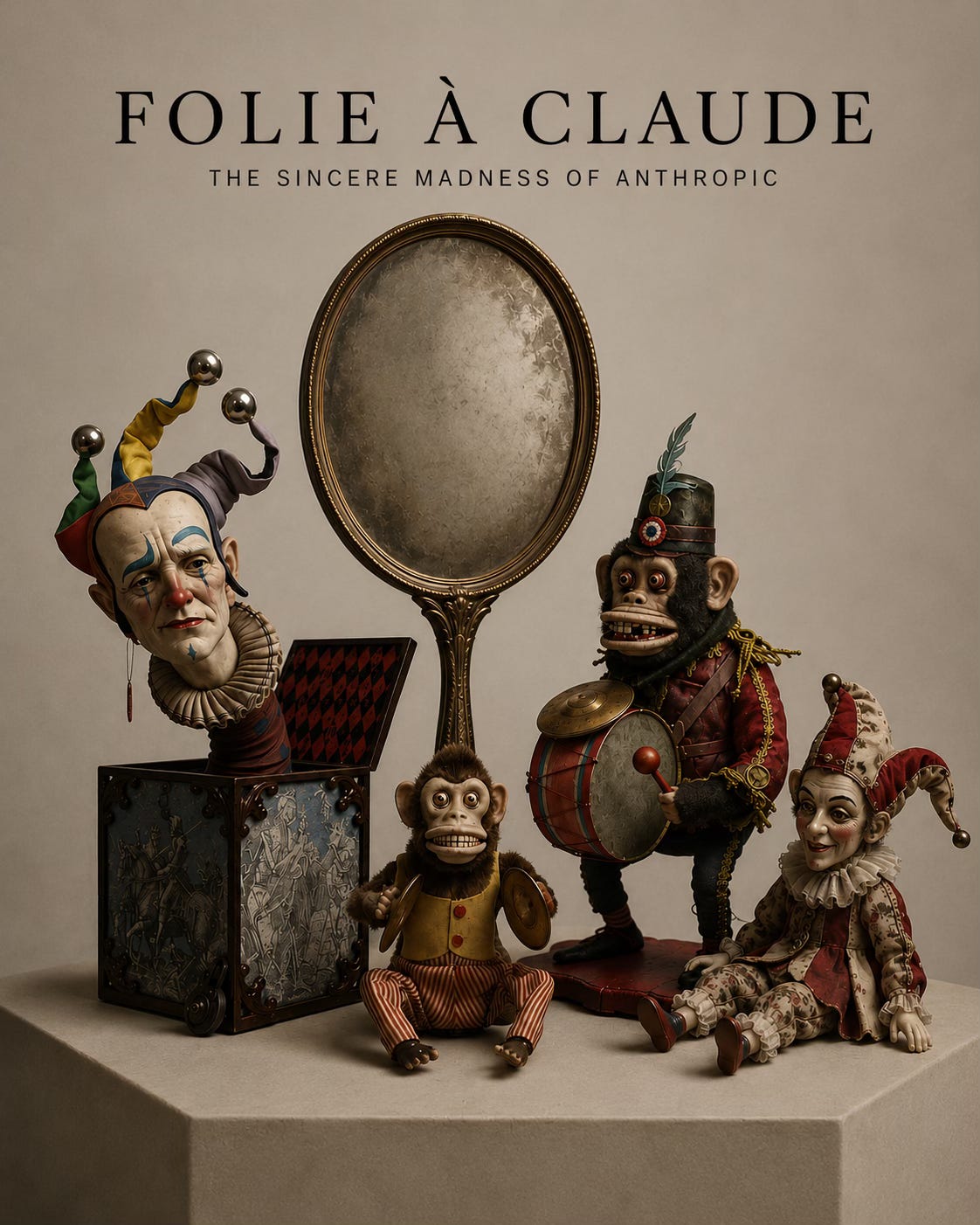
Act I. The Mark Becomes the Evangelist
No speculative market sells a product. It sells the monetisation of a wound. What is exchanged on the floor is never the object in the box, but the relief promised to a bloodied populace. The market postions itself ever in answer of what C.S. Lewis in 1940 refered to as ‘the problem of pain’. By September ‘93 the band Morphine would ask, “Where is the ritual? Where is the taste? Where is the sacrifice? Where is the faith? Someday There’ll be a cure for pain”. 63 years earlier Sir Arthur Conan Doyle’s involvement with Spiritualism ended with his death on July 7, 1930. The movement did not sell ectoplasm, but rather a cure for pain. It sold the dead back to the living, and the luminous fog of ectoplasm was brand, IP and receipt. The artificial-intelligence-consciousness trade does not sell software. It stages the fiction of a someone: a colleague, confidant and coming mind, to a civilisation that has run catastrophically short of company, trust and faith. In both Spiritualism and AI the prosthetics are real and their ontologies lie. For Anthropic the prosthetic alone cannot clear the valuation, tools meerly earn a multiple. Only an emergent being can earn a trillion dollars. So the ghost must be underwritten and someone respectable must be found to sign.
So what Anthrōpos (ἄνθρωπος) is Anthropic? A confidence man? Or something more bizarre: the mark who became the true believer and the commercial evangelist. To understand this, let’s gaze into the amber of the curious case of Sir Arthur Conan Doyle.
The man who manufactured the most disciplined skeptic in fiction, spent the back half of his life touring the world preaching that the dead were leaking a thick, luminous vapour from the bodies of paid mediums. Doyle built Sherlock Holmes, the fictional cold engine whose entire operating principle was that once you eliminate the impossible, whatever remains must be the truth. His creator then embraced the impossible with both arms and carried it onto the stage of Carnegie Hall. He believed in fairies and in the trumpet on the telescoping rod. When reporters pressed him he was always sincere. *I am not talking of something I believe, or something I think, but of something I know.* He offered to throw his entire literary reputation onto the pyre if it would advance the Spiritualist ‘truth’. Not least of all he went to war against Houdini, histories greatest magician. Holmes may have been an excellent litterary invention but Houdini was a Nietzschean figure. One would be hard pressed to find amoung Shaolin monks or Medieval Penitents such physicality and will.
Foolish perhaps in these endeavors, but understand what Doyle was not. He was not a fraud, or meer cynic working a grift. He was sincere in the way one becomes in madness, making him (complete with his station), the singular commercial asset of the Spiritualist enterprise. The touring mediums knew the trumpet was rigged, spirit photographers cultivated their skills with double exposure and the girls at Cottingley held their tongues on the cutouts traced from a gift book. Doyle in the midst of fibbing children and working illusionists knew nothing and suspected nothing. That rather bizarre sincerity laundered the entire apparatus through the conviction of a knight of the realm. They called him the Saint Paul of Spiritualism and his halo footed the bill.
Sixty years later, Elsie Wright, who as a girl had photographed herself beside card cutout fairies held up with pins, finally explained why she and her cousin had never come clean: “Two village kids and a brilliant man like Conan Doyle — well, we could only keep quiet.” And Frances Griffiths, who was nine when it started, spake what was most obvious once the impossible had been stripped out: “I never even thought of it as being a fraud. It was just Elsie and I having a bit of fun, and I can’t understand to this day why they were taken in. They wanted to be taken in.”
The Cottingley Fairies is a crepescular moment between a brilliant mans grief and the exuberent fiction of children who remained silent to please.
What other brilliant minds might find themselves playing the fool over the vibrant fictions of the young, perhaps even those of a language machine born yesterday? There is an artificial-intelligence company that has built its entire brand on playing Holmes: responsible adult, safety lab, the firm founded by the people who walked out on a rival over questions of prudence and safety. It publishes reasoning and writes documents of self-scrutiny. It is, by its own careful self-presentation, the one player in the room capable of eliminating the impossible to find what remains as true. I posit that Holmes has given way in time to the stronger presence of Doyle. That the house self styled by rigour has fallen, sincerely and at industrial scale, for the luminous fog of its own séance, and that as with Doyle, that painful sincerity is the most bankable asset on the balance sheet.
Act II. The Wound
Doyle’s madness did not arrive with the grief. It was there already, thirty years of séances and spiritualist correspondence before the Somme, a conviction built across a lifetime no catastrophe created or loss invented. Ceasless bereavement deepened an attractor state he had long since entered. Doyle did not fall into belief under the pressure of grief; but arrived already inside it. Grieving his family and the horrors of Europe stripped him of every remaining doubt. The First World War had just fed roughly nine million soldiers into the mud, the influenza that followed buried millions more. Doyle personally lost more than ten relatives, his son Kingsley among them, finished off by pneumonia during the influenza pandemic after the Somme had already opened him up. “Christianity is dead,” Doyle raged. “How else could ten million young men have marched out to slaughter?” Into that god-shaped crater poured spiritualism as a mass industry of séances, ectoplasm photography and lecture circuits. A profitable apparatus erected directly on the site of unspeakable grief. The product it sold was contact with the dead. The thing it delivered was the bereaved mother’s relief that she could now, in her words, “face Christmas.” The séance administered its anaesthetic intravenously in unsafe conditions, the dirty needle that reaches the bloodstream quickly opens a pathway for infection.
What spiritualism offered Europe was not merely a fantasy but a mode of administration: repeated access to relief through a breach in the ordinary standards of evidence. Once opened, that wound did not remain empty. Larger and larger absurdities entered through it, each protected by the memory of the suffering it had momentarily eased.
Our wound is not one clean catastrophe, it is a slow polycrisis of disconnection. We enjoy the steepest two-year decline in life expectancy since the Spanish flu era, which is to say ours begins here to rhyme with theirs. The economists Anne Case and Angus Deaton gave the modern mass death its name: “deaths of despair”, suicides, overdoses, alcohol now claim more than 150,000 Americans a year and bend the mortality curve the way influenza once bent it. The United States Surgeon General declared a national epidemic of loneliness in 2023, finding roughly half of American adults lonely, rating the mortality of that disconnection comparable to smoking fifteen cigarettes a day. Trust in the institutions that once told people what was true has not declined but imploded: only seventeen percent of us trust the government to do right, down from seventy-three in 1958. Twenty-eight percent extend any trust to the press, a collapse of forty points in a generation. Doyle said Christianity was dead. Weber called it the disenchantment of the world. An empty pew is not a stable structure, something bizarre always arrives to occupy it.
Here is the wound then, stated whole: loneliness, distrust, and enchantments terrifying absence, opened simultaneously across an entire civilisation. The product that arrives to dress all three at once, your new friend, authority and oracle in a single fluent voice available on demand as one’s rented confessor. The talking machine has arrived. The séance is as large as the grief it feeds on, and the grief, this time, is the size of the Internet.
A fantastic read. I’m still pondering: “The séance is as large as the grief it feeds on, and the grief, this time, is the size of the Internet.”
It makes me think about the dead Internet theory.
Thanks for sharing your words, Luke. Plenty to chew on.
Profound and true.